Showing posts with label cross stitch. Show all posts

Framed Cross-stitch bouquets

Hi flower-lover!

This one is exclusively for you who love flowers and who love cross-stitch!

Would you believe that these framed pictures are of flower bouquets, which are oh-so-realistic, are not painted, but embroidered? 

Yes, it is true!

They are embroidered with cross-stitch where the stitches are so few, but use so many shades of color, that they seem to pop out of the picture frame..

Now for the artist.. It was my mother who has created these masterpieces.  She intends to do 2 more, after having completed this pair. 

Here are closeups of the two flower bouquets, one with yellow roses and one with red roses.  The photo frames have been selected to enhance the embroidery..


Cross-stitch: Norwegian motif - my best one yet!

"Take your needle, my child, and work at your pattern; it will come out a rose by and by. 
Life is like that - one stitch at a time taken patiently and the pattern will come out all right like the embroidery. "
~Oliver Wendell Holmes
Cross-stitch.. that lovely needlework technique which I am passionate about.. I can never seem to have enough of it.

And here is one fantastic piece, my best one yet!  


I took more than 3 months to complete this one !! 


The pattern is a Norwegian/ Scandinavian one, and while the original design was in black on white aida, I chose a maroon silk thread on a cream/offwhite colored aida for this piece.


The pattern consists of bands of back stitch and cross-stitch motifs.


The middle band is the most complicated one and takes the longest to finish.

The other two prominent bands consist of rows of Scandinavian style flowers/snowflakes.


Holy Cow!

We Indians love Cows!  We adore them, worship them and find a zillion uses.

My family has had a century-old tradition of rearing cows and we pamper them just like our own kids, unlike many who sadly let these gentle animals to feed on their own in the streets.

A picture of some of our family cows
"If someone were to ask me what the most important outward manifestation of Hinduism was, I would suggest that it was the idea of cow protection," Mahatma Gandhi, India's legendary nonviolent leader, once wrote.

Here is a picture of our extended family members-both young and old and all female:)  Our friends here, share our house and hearts and occupy a central place in our daily lives. 


My kids wanted me to immortalize our ties with these wonderful creatures, and I picked up a fun-filled chart to embroider.  Here is the finished piece to be framed, and below is the original chart.
My Cow embroidery piece
Original chart from the published Cross-stitch magazine

I used cream-colored aida for this piece.  I made a few changes with the original chart in the colors and added plants and clouds in the background to give a cleaner and more natural look.  I also used lustrous skeins for more shine.

Hopefully, this inspires and infects our other crafters with my passion!


Self-threading technique on Aida fabric

Most of us use Aida fabric primarily for stitching Cross-stitch.  But one could also try out this variation where I used the threads drawn out of the fabric itself to re-thread it through the mesh holes thus created.  

My pink and green Aida tablecloth
One can use either the same color as the fabric or interchange it with another similar fabric color to achieve different results.  Here I have interchanged colors using the pink for the background and the green to thread through the holes and make flowers at the corners and run through the remaining part of the tablecloth.

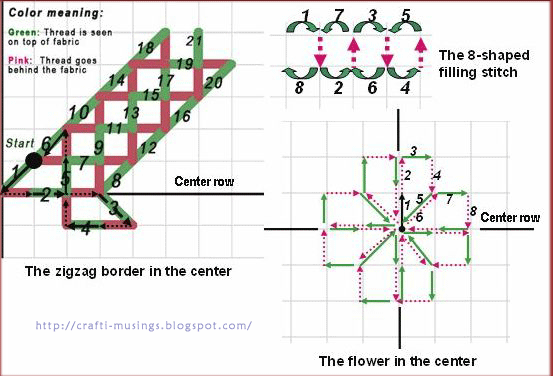
A closeup of the center of the tablecloth showing the cluster of flowers as well as the zigzag border around it
Instructions
  1. Systematically pull out the threads on every fifth weave row to the eighth weave row, i.e. 4 rows present and next 4 rows pulled out;
  2. Repeat this process along the length of the whole fabric in both directions/axis thus forming a square grid with holes;
  3. Use and store the pulled-out threads of the fabric to form separate skein bunches;
  4. Mark the center of the fabric, and create the first flower by starting a skein in the center grid and threading it through the surrounding holes first up then down through the hole, then up again and complete the flower by going backwards through the remaining holes of the flower.
  5. Add subsequent flowers on each side to form a cluster as shown in the second picture.
  6. Use the same up-and-down threading technique to form the zigzag border around the central bunch.
  7. Make similar flowers at the four corners and at the center of each border.
  8. Thread the remaining holes using an 8-approach, both in the center and the rest of the tablecloth in opposite directions, as shown in the first picture above .
  9. Finally seal the edges of the tablecloth by making tassels out of the remaining threads.
  10. The threading technique is shown below:

Grapes are not always sour!

”The juice of the grape is the liquid quintessence of concentrated sunbeams..“
says Thomas Love Peacock!


Here is a tablecloth I embroidered in cross-stitch with grape vines going round.

The closeup of the grapevine has grape bunches dangling deliciously.

I have used two shades of green for the vine and leaves, and maroon and purple for the grapes.

The pattern is from a Norwegian cross-stitch book from the 80's.

Blue and White - A stitcher's delight!

"Embroidery is the art of enriching a fabric with stitchery." it is rightly said!

Here are few more of my enriching experiences..

Tablecloth in patchwork
 
 I experimented with a Blue and white combination using the log-cabin patchwork technique, to create this square tablecloth.

I have used a fabric with elephant motif and placed a patch with a single elephant in the center, then a singular blue-colored row around it, then again a band of the elephant motif fabric.

I finally seal the tablecloth with a broad piped border of the same blue colored material.

As for your own choice, you can increase or decrease the size of the tablecloth, by adding the rows over the previous one, and by increasing or decreasing the width of these rows, to create and achieve different effects.


 Cross-stitch + Hardanger

This piece is an inspiration from the antique farm houses of Norway, very well researched and documented in a book in Norwegian.

The original piece as published in the book is a long rectangular table cloth used as a mantelpiece in an old and famous farmhouse.

The author has reproduced the design, and I have stitched only two squares based on the original pattern.  I have used the pulled/drawn thread embroidery technique along the edges.

Here is a closeup of the pattern with two squares, which can be repeated as desired along the length of the fabric.
My other creations using Blue and White combination:
  • My Hardanger doily in an earlier post:  Click here.
  • My  tablecloths using Cross-stitch in an earlier post: Click here.
  • My String art Wall piece and Peacock in an earlier post: Click here.

Half-cross stitch on plastic mat

Half cross-stitch as the name suggests is the stitching of only one half of a typical X in cross-stitch.  However, it can independently lend itself to creation of beautiful pieces of needlework.  Most of the time it is used on tapestry and canvas.

I tried out this cross stitch design using the half cross only on a rectangular plastic mono canvas mat.  You can also try out the same technique for making purses, on totes and bags, bookmarks etc.

I used a shaded maroon crochet cotton thread for a roses design and added a border along the edge of the mat. Here is a closeup of the center of the design.
Closeup of plastic mat with half cross-stitch


Stitching a half cross - illustration
 Check out this website and this one for free tapestry designs, to get going!..

My Cross stitch creations

"I cannot count my day complete  'til needle, thread and fabric meet..." said an avid stitcher like me.

I am a CROSS-STITCH lover and I can never have enough of creating wonderful home decor things with this simplest form of one of the oldest forms of embroidery!  I am also a member of the I love cross stitch group on Yahoo groups.  Like to join?  Click here.  
Here is a sampling of the pieces I have created with this wonderful stitch and I am always brimming with more ideas, but feel that one lifetime sadly  is not enough!!!!  

Do let me know if you want charts of any of these creations for yourself.  Keep checking as I will add more creations..

Click for larger view
Kashmiri-style
Here is a piece of Kashmiri cross stitch motif I embroidered on white aida.  All the colors are shades of blue.

The pattern is from the Indian edition of Anchor Needle n Thread magazine.  You can subscribe to this magazine here.


Purple buds
Click for larger view
 Here is another tablecloth with a cross stitch flower motif in the corner.

The colors used are lavender, purple and sea green and I have stitched a lavender-colored lace along the border.


Butterflies

Click for larger view

This oval-shaped table cloth was embroidered with a cross stitch motif containing butterflies, flowers and leaves.


I used a brown-colored lace around the border.
Here is a close-up of the butterfly motif.
Click for larger view


Blue on cream
Here is a variation of the cross stitch on a fabric having large countable holes.  I tried 3 different stitch variants to create a new and different type of effect on a table runner, using this cream-colored holed fabric I found at the local furnishing shop in Norway.
Click for larger view
 If you look closer, you will notice that there is already an inbuilt design in the fabric at regular intervals.  I therefore stitched my motifs in-between these designs along the length of the runner. 
I finally added fringes to both ends of the runner using the fabric's own threads. 

 Here are close-ups of the three motifs.
Click for larger view

Click for larger view

Purple square
This one is a small square table piece with a simple motif which I stitched using only one color- purple on white aida.
Click for larger view

I repeated the base design around all four corners of the center and added a white-colored lace for the edges.